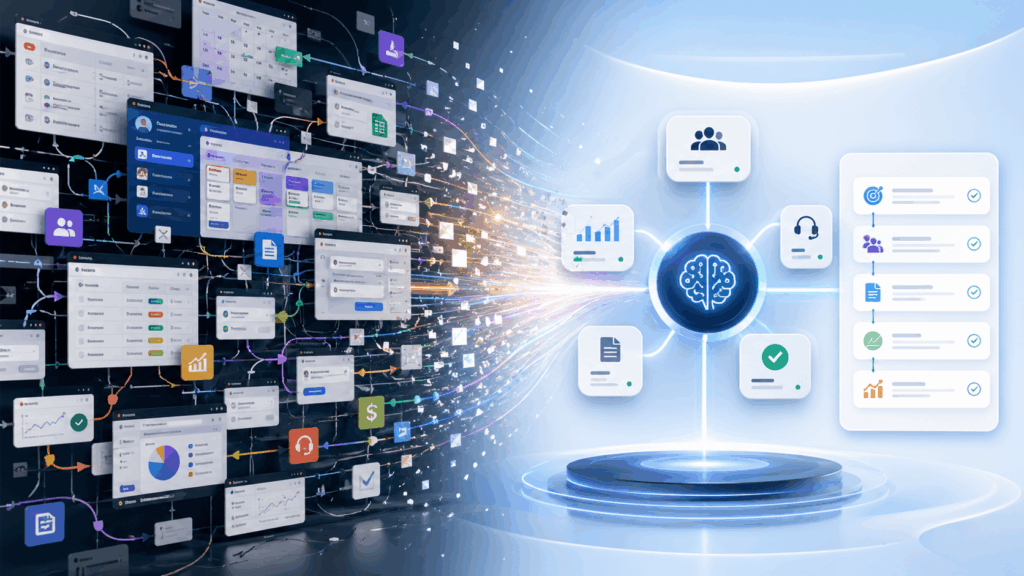
For the last two decades, the default answer to every business problem was: buy another specialized cloud tool. CRM for sales, helpdesk for support, HRIS for people, BI for reporting. Something for procurement, planning, workflow automation, contract management, and then some integration layer like Zapier to pull the pieces together (hopefully).
Sure, this was a huge improvement over clumsy, expensive, on-prem installed enterprise software. SaaS made software much easier to buy and deploy.
But it also created a strange effect: companies outsourced more and more of their internal structure into dozens or hundreds of point solutions. You adapted to somebody else’s idea of a process, piece by isolated piece.
Every function got its own dashboard, and each of those created its own version of reality. Every workflow generated more handoffs, integrations, meetings, and eventually a team to manage the system. Whole categories, like “the modern data stack”, were created around this complexity. SaaS reduced deployment friction, but made coordination much more complicated and processes more fragmented.
AI is now pushing us in the opposite direction, almost back to a past where software was much more custom and deeply integrated.
If software becomes easier to build and operate, the advantage will shift away from buying the best point solution for every sub-task. It will shift to owning the full workflow again, but not in the old monolithic ERP sense with its over-customized SAP instances.
This future could look more like a modular full-stack company, built from highly customized components.
A lot of SaaS exists because doing the work manually was too labor-intensive and building custom software was too expensive. AI changes that equation. It lowers the cost of automated service delivery, the cost of software creation and the cost of integration.
In many situations, the question of the future is not going to be: should we use a software product with a standalone UI and a bit of AI on top of it? It is: should we use a traditional SaaS product in the first place? Or should we rather use AI to build a system that pulls intelligence and functionality from the best sources, then bundles it in a way that makes the most sense for our company?
This is not the same as “everybody is going to vibe-code their own CRM”. It is more like assembling a solution from the best Lego pieces of functionality, combining them with deep business context, coordinated through highly specific agents.
Of course we’re already seeing this trend in the market. Salesforce just announced a new strategy that lets users access its functionality in a “headless” way, i.e. directly from AI agents through MCP, APIs and CLIs. The CRM is not a full app anymore, but a library of capabilities that can be remixed.
OpenAI and Google just announced new agent platforms, providing powerful capabilities to do exactly this remixing. And OpenAI also started new implementation partnerships with large systems integrators, because somebody has to build these custom solutions. Recombining the whole stack is powerful, but far from trivial.
That opens the door to various forms of re-bundling. As Netscape co-founder Jim Barksdale once said: “In business, there are two ways to make money. You can bundle, or you can unbundle.”
Historically, fortunes were made in tech when one of these unbundling-rebundling cycles happened.
Frequently, the owners of the old bundled solutions were the losers (just ask IBM, AOL or Nokia). This might be why financial markets are punishing SaaS stocks so massively: They are selling a product that is not shaped like the future.
The winners were the providers of the best components (like Intel and Microsoft in the PC cycle) or the ones that provided the best integrated bundles (like Apple with its rich ecosystem).
We are already starting to see some of these patterns: The big four providers of AI platforms (OpenAI, Anthropic, Microsoft, Google) are trying their best to build an integrated stack that allows third parties to plug in their own components. They want to own the bundle, but they need other providers to bring their value to the platform.
Other companies are bundling on a different layer: That of a complete service that provides a defined outcome. This initially looks more like consulting, but it can turn into a complex hybrid business. Palantir is of course the best example for this, and we are seeing similar patterns in legal, finance, industrial solutions and even robotics.
Yet other companies provide the modular building blocks, both in terms of infrastructure (such as AI agent optimization) as well as business functionality, for example rich data APIs for specific problems. It’s quite hard to avoid commoditization at this layer, but if you can find an attractive niche, it can be lucrative.
All of this is uncomfortable for entrepreneurs and investors alike because it breaks familiar categories. Gross margins may be messier. The roadmap and pricing model may be more complicated. The early product may look suspiciously like consulting, or it might look like a narrow feature. You might end up playing in somebody else’s walled garden, with all the downsides of such dependencies.
But there is no way around it: The way software solves problems is changing fundamentally. The stack is being rearranged completely. And there are opportunities everywhere in this new environment.
Maybe SaaS was not the final form of software. Maybe it was just the unbundling-bundling phase before software could become a deeply integrated part of the work again.