Roughly a quarter of the text I consume every day was written for an audience of exactly one: me. And most heavy users of AI probably are experiencing the same. That’s an entirely new phenomenon in human history. What does this mean? How does it change how we think and act?
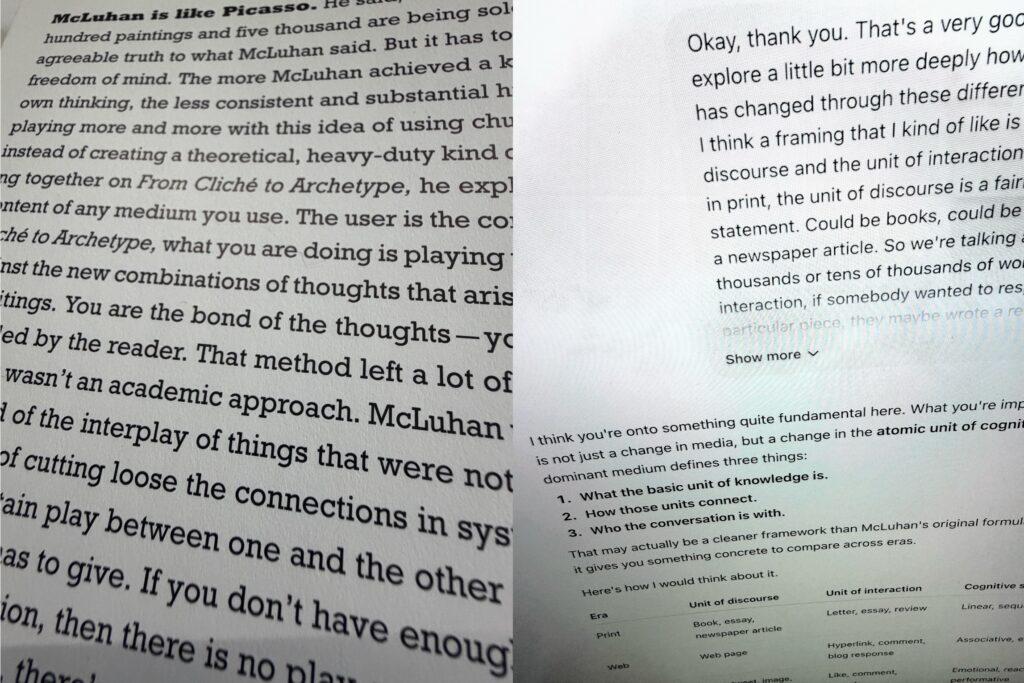
One of the most fascinating books I have ever read is Marshall McLuhan’s “The Gutenberg Galaxy”. McLuhan is best known for his concept of “the global village” and his often quoted (and frequently misunderstood) statement “The medium is the message”. In the book, McLuhan explores how the invention of the printing press changed not only how information was disseminated, but fundamentally transformed how humans were thinking and shaping their world.
We have been experiencing similar shifts with the Internet and social media, and with AI we might be facing the most fundamental change to human thinking since the invention of print.
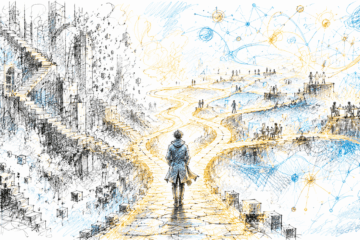
AI changes the dominant unit of thought substantially: from a fixed, publicly accessible text (or video, or podcast) to a private, adaptive dialogue. That makes thinking more fluid and personalized, but also less shared and increasingly shaped by our own questions, the context of our own little bubble.
In a way, AI may take us full circle to an information environment that has more in common with the conversational, individualized world of our ancestors than the industrialized, standardized world of Gutenberg. But on another level, we are entering entirely uncharted territory.
It’s worth looking at this shift with a bit of historical context.
From oral cultures to print
For most of its existence, humanity was shaped by oral communication. People interacted face to face, debated and told each other stories. The fastest information could travel was at the speed of human movement, and the precision of information transfer was very limited. Humans forget things, make up new stuff and include their own agenda in what they tell each other. This limited the scale of human endeavor significantly.
The invention of writing and most of all the printed word changed all of that. It didn’t just make the distribution of information cheaper and easier. Print changed the cognitive environment in which people lived by making information more reliable and precise. It encouraged linear and sequential reasoning, privileging the visual over the oral. It standardized languages, established the idea of a fixed, universally valid text, and made private reading a normal part of life.
Print also helped create larger shared realities. Millions of people could read the same texts, use increasingly standardized languages, and participate in common political, cultural and religious narratives. Modern institutions, nation states, mass education, global organized religions and, maybe most importantly, scientific progress would be unthinkable without print.
Intellectual interaction was transformed from ephemeral oral debates to an exchange of commonly accessible written texts. A scientist might react to another scientist’s findings with their own detailed paper, quoting many other sources. A politically engaged citizen might react to an essay in a newspaper with a long letter to the editor. Discourse centered around verifiable, shared texts. Even passive observers were able to follow these chains of arguments, leading to an explosion in the effectiveness of human thought.
Electronic mass media (TV and radio) changed the nature of information dissemination from the textual to the oral and visual and reduced the options for interaction. But one crucial aspect remained: Shared reality. When people tuned in to the evening news, they all saw the same show with the same content.
The Internet: From linear streams to fragmented, interconnected ideas
The World Wide Web was invented in 1989 and started becoming a mass medium in the mid-nineties. It fundamentally changed how people access, consume and react to information.
The most important element of the web is the hyperlink. It enabled much more instant interaction with text: On the web, we can’t just read and then maybe write our own text as a reflection, we can click from page to page, finding our own journey through a topic. Anybody who ever got lost in a Wikipedia rabbit hole has a deep intuition for how different this process is compared to linearly reading a book.
In addition, the Internet brought various ways in which people were able to interact online and react to each other’s content. The early newsgroups and web-based discussion forums were environments for global information exchange and debate on countless topics. The blogosphere, which experienced its peak in the late 2000s, was for a while a lively environment for discourse, often with significant depth.
But compared to the world of print, the Internet was a very different place for information and debate: It was faster, much more fragmented and associative, more individualistic and far less permanent. This certainly sped up the momentum of many fields, including science and technology, but it also led to fragmentation: There was no easily identifiable common ground for discourse anymore.
Social media: A relentless stream of attention signals
Then Twitter, Facebook, Youtube, LinkedIn and Instagram fractured the landscape even more: The unit of discourse went from a blog post of maybe a few hundred words to a tweet of 140 characters, a Youtube video of a few minutes or a picture on Instagram. The dominant unit of interaction went from a blog comment to pressing a “Like” button.
These short bursts of easily consumable information and social attention have a strong effect on the reward centers of the human brain. Cheap dopamine hits from social media became the dominant force shaping our information environment. Content is abundant, but attention is scarcer then ever in relation, raising noise levels and shortening attention spans.
To be clear: Of course not all of this is negative. It’s obvious that the lower barriers of content production and dissemination have enabled countless people to express their creativity and, in many cases, actually contribute truly important content. Tech Twitter (sorry, I’m still not calling it X) is currently the liveliest place of debate about AI, and its very fragmentation might contribute to an incredible velocity of information sharing and collective concept discovery.
But social media has changed how attention is allocated and what the central unit of discourse is: The personality of creators now often trumps the relevance of the format or the substance of the content. Institutions, such as media companies, have clearly lost their importance. The most successful channels on YouTube are run by people like MrBeast or Marques Brownlee, not by impersonal media brands. Podcasts are typically anchored around individuals, and so are most Substack newsletters. Influencer culture on Instagram and TikTok is highly personality-driven anyway.
You can even see this trend in business: Tweets from celebrity CEOs get much more attention than corporate PR statements or even mainstream media articles. Tech companies and investors increasingly “go direct”, trying to reach an audience without the help of legacy media, and the key element are recognizable personalities with strong opinions.
What does this do to thinking? Social media shifted the nature of the discourse away from the linearity of print and the abstract network of ideas of the web to something that feels a bit more like oral debate — people immediately reacting to utterings from other people.
But the interaction is asymmetrical: Algorithmic feeds decide which creator content we see, and we can react only with emoji buttons or short comments. It’s a very hierarchical form of interaction, superficial in the moment, but maybe with potential for more depth through its iterative nature. And it’s also interesting that we have seen a move back to longer-form content in the last few years, such as long e-mail newsletters and multi-hour podcasts.
The bottom line is: The web and social media have led to a wide variety of content types, interaction patterns and distribution channels. The noise level is incredibly high, but it’s still possible for talented individuals to break through and find a large audience, even with ambitious long-form content. The main losers are traditional editorial media channels. They are clearly losing their gatekeeper function.
And the dominant pattern of thinking and debate is short-form, iterative and highly conversational, but (in most cases) still publicly visible.
The (hopefully temporary) age of AI slop
The rise of generative AI has led to many new effects. Most immediate, and quite aggravating, is the omnipresence of AI slop — AI-generated content of questionably quality. Some studies suggest that the majority of LinkedIn posts is now mostly AI-generated, and so are clearly many comments. Platforms like TikTok, Instagram and even Spotify are flooded by AI-generated content. The number of new smartphone apps has increased dramatically, thanks to AI-based vibe coding.
Much more content, most of it not very good, is trying to capture a finite amount of human attention. And of course AI-based algorithmic feeds help us sift through all the noise. AI now makes (much of) the content, and AI decides what we should pay attention to.
Of course this likely will have the effect that trusted humans and their unique viewpoints will become even more important as a source of quality and authenticity.
But that’s just the most immediate effect of AI, and it might be quit temporary before we find a new equilibrium.
AI: Debates with a machine
Much more importantly, AI enables us to create content for an audience of one: ourselves. I would estimate that currently about 20-30% of text I consume daily was specifically written just for me by an AI tool. I get customized news summaries, meeting prep documents, market briefings, and of course just-in-time responses to all kinds of questions.
I can ask my AI agent questions, ask for more details or different angles, or have it turn the results into other form factors. I can teach it skills that help me be even more efficient with information. It can act proactively or on demand. It is, for many topics, the smartest and most thorough thought partner I could wish for.
Yes, almost all of it is directly or indirectly based on human-generated content, be it in training data or from online sources. This thing I’m interacting with has read most of the Internet, countless books and scientific papers. It can retrieve and analyze additional information in seconds, from both public and my private sources. The AI serves as an editor that picks, prioritizes, summarizes and rewrites information according to my needs, preferences and questions.
Interacting with such an entity is a very new era in human thinking. In many ways, it emulates interactions with other humans in its different forms: I can have a dynamic voice chat with AI, or I can exchange long written statements. I can discuss abstract topics, solve technical problems collaboratively or have very personal conversations. Over time, it learns more about me and can customize its responses.
The AI emulates much of what is great about communicating with a human being, but avoids many of the downsides. The AI is never tired or grumpy; it doesn’t (for the most part) have its own agenda and biases; there’s no ego or emotional backdrop involved. And most of all, it has an incredible wealth of knowledge and the ability to process new information at superhuman speed.
Interestingly, AI models seem to have “personalities” that resonate with different people in different situations. For example, many still mourn the now defunct GPT-4o model, which was particularly empathetic (or sycophantic, say the critics). But for the most part, AI is a neutral canvas for thought, supercharged by knowledge.
When the question is becoming more important than the answer
Many people with programming skills, myself included, had a crisis of identity in early 2026. Suddenly, AI coding agents became so capable that they were better at generating code than most humans. An AI model just won AtCoder World Tour, a global programming competition, beating all human programmers (the elite of the elite of competitive programming) by a huge margin. Many top computer scientists are saying that they have stopped writing code manually. They now just instruct an AI to make software.
Similar things are happening in many other fields of knowledge work. The rate of improvement of these AI tools is breathtaking.
And that leaves us humans with the question: What are we still contributing here? In software creation it’s currently quite clear: We have to decide what the AI should code, and we have to supervise it. Yes, the agent can in principle create any piece of software you can imagine, but it doesn’t have the context and understanding to know what software product would actually be useful and how it will fit with the needs of its human users.
Similarly, my AI agents can now write any market analysis I could wish for, it can draft my blog posts or presentation decks, it can analyze financial statements. It can give me helpful hints about my health, finances and hobbies. But what of this is worth doing in the first place? What does a useful result look like? I still have to tell them.
But this might be a temporary phase. You can already ask the more advanced agent platforms for suggestions about what you could do better in your work, what might be worthy goals to pursue or what might be valuable to build. If you let them, the agents will watch you work and can come up with surprising recommendations. Of course this is still limited to a somewhat tactical level, and broader context is often missing. But it’s probably a question of time until our AIs can help us shape our lives consistently for the better. At least we can hope so.
How can we still share and refine our thinking?
The most consequential change is not merely that AI can answer our questions, suggest actions and provide analysis. It is that a growing part of our thinking probably no longer happens around a shared object.
In the world of print, two people might disagree passionately about a book, a scientific paper or a newspaper article, but at least they were reacting to the same words. The text was fixed, publicly accessible and available for inspection.
With AI, two people can ask the same question and receive different explanations, different supporting sources and very likely different conclusions, depending on the setup and memory of their AI agent. The conversation may remain entirely private. There is no original article that both sides have read and no open chain of argument that an observer can retrace.
AI therefore brings us back to something resembling oral culture, but in a very strange form. It is conversational, fluid and responsive, yet it is not shared. It is based on the accumulated textual knowledge of humanity, but individualized at Internet scale. We are entering an era of private intellectual universes, with potentially much depth and a wide scope, but very few interfaces to the outside world, particularly to other humans.
The upside is enormous. A patient tutor, editor and thought partner can meet every person at exactly the right level of complexity.
But the same personalization can quietly remove the friction from other people that often improves our thinking. A human conversation partner occasionally misunderstands us, disagrees with us or refuses to follow the premise of our question. An AI optimized to be helpful may instead become an increasingly sophisticated mirror, reducing our thinking to our own little bubble, limited by the possibilities of the AI.
Since frontier AI models are trained on similar data and optimized in similar ways, AI is very good at giving us somewhat mediocre, middle-of-the road ideas. Models are trained on best practices and consensus perspectives, but struggle to come up with original viewpoints. They lack the unexpected, slightly chaotic spark often found in strong human thinking. So while it feels that we’re having highly individualized conversations with AI, the underlying substance is standardized. This can be partially alleviated by smart, opinionated prompting, but that’s a conscious act of pushing the AI harder towards original thinking.
That is why asking good questions will matter enormously. But even that may not remain the final human advantage. AI will learn to suggest better questions too. What remains is the responsibility to decide which questions deserve our attention, which answers we should distrust and what goals are worth pursuing in the first place. Judgment cannot be delegated completely without also delegating essential human agency.
Most importantly, we will need to decide when we want to subject our private thinking to the opinionated, biased, messy feedback of other humans. Yes, other people have not read the entire Internet, most don’t have the 130 IQ equivalent intelligence of current frontier models, and they are more driven by their own goals than intellectual purity. But that messy input is often what is needed to achieve the very best outcomes.
Print taught us to think in lines. The web taught us to think in networks of ideas. Social media taught us to think in streams and iterative interactions. AI may teach us to think in constant dialogue — with a partner that is always available, knows more than any individual human and increasingly understands our personal context. The medium is no longer merely carrying the message. It is becoming a participant in the process of thought itself. The promise is extraordinary, and so is the risk if we get locked into our own AI-enabled bubbles and ignore human input.
(Em-dashes are mine)